Procurement Methods in Construction: Main Options

What are the procurement methods in construction?
The three types of procurement methods in construction used on most US commercial work are design-bid-build, design-build, and CMAR. The US construction industry calls them project delivery methods, while UK sources say procurement routes. A joint primer on project delivery terms from the AIA and AGC defines all three and notes that no single method is right for every project.
Design-bid-build: the traditional procurement method
Design-bid-build is traditional procurement. The owner hires a designer first and a builder second, most often by competitive bid once drawings are complete, so design and construction run as separate phases.
For the trades, this is hard-bid work. The material prices you carry on bid day are yours to hold until buyout unless the building contract includes escalation language.
Design-build: design and construction services under a single contract
Design-build puts design and construction services under a single contract with one entity, which gives the owner one point of responsibility and lets the design and construction phases overlap. It keeps gaining ground. A DBIA and FMI study reported by ENR projected that design-build would account for 47% of spending across 11 nonresidential segments through 2025, up from 42% in the previous five years.
Early contractor involvement helps the project schedule, but it also means you're pricing materials against drawings that are still changing. Order-by dates move earlier too, so the procurement schedule often gets built before the drawings settle.
Construction management at risk (CMAR)
Under construction management at risk, the owner hires a construction manager during design to provide preconstruction services. Once construction starts, the construction manager acts as the builder: it holds the trade contracts and carries the risk of delivering the work, often under a guaranteed maximum price (GMP). Some owners call this CM/GC.
For trade contractors, CMAR tends to mean buyout in packages as the design firms up, and your price holds only as long as the project scope behind it does.
How construction procurement methods compare for the trades
Here's how the types of procurement methods in construction compare from the trade contractor's side.
What are the alternative procurement methods in construction?
Alternative procurement methods in construction include integrated project delivery, management contracting, and public private partnerships. Project owners turn to them on large projects and complex projects where a traditional contract is too slow or puts too much of the project risk on one party.
Integrated project delivery
Integrated project delivery (IPD) brings the owner, designer, builder, and often the major trades into one multiparty agreement from the start, so cost overruns and savings land on the whole project team. Few teams use it on everyday commercial work because it takes a lot of trust and careful planning up front.
Management contract: when a management contractor runs the trade packages
Under a management contract, the owner hires a management contractor to run the work and answer for the trades, with packages let in stages, often before design is finished. It's more common in UK and international work, and the final project cost stays uncertain until the last package is awarded.
Public private partnerships on major infrastructure projects
Public private partnerships pair a government agency with a private sector partner that finances, builds, and often operates the asset in exchange for long-term payments. They show up on major infrastructure projects such as transit and other civil engineering work, and trade contractors feel the method mostly through heavier documentation and regulatory compliance.
How does the procurement method change when trade contractors buy materials?
The procurement method sets how long your material price has to hold and how much the scope behind it can still move. Design-bid-build stretches the gap between pricing and buying. Design-build and CMAR shorten it, but the scope keeps shifting, so quantities and specs get repriced more than once over the project lifecycle.
What public project data shows about cost growth by method
Picking a method doesn't fix cost outcomes on its own. A Federal Highway Administration review of US highway projects found no statistically significant difference in cost growth across the methods it studied:
Highway work differs from commercial building, but the point holds for the trades: the method moves risk between parties, and how well you buy determines how much of that risk ends up as lost margin.
Where material price exposure shows up on commercial projects
On commercial construction projects, the exposure tends to show up here:
- A vendor quote that was good on bid day can be weeks old by the time the first PO goes out on hard-bid work, and supply chain disruptions make that gap more expensive.
- On design-build and CMAR work, the master PO you set against an early estimate gets released and revised as drawings change.
- Long jobs often need fresh quotes halfway through the construction schedule, because pricing locked at the start stops holding.
On a CMAR or design-build job where you're buying against a design that's still moving, what's the first thing that goes wrong with material pricing, and how do you protect the number you carried?
“The first thing that goes wrong is that the original pricing gets treated as fixed even though the design, quantities, and specifications are still evolving. You end up with scope gaps, substitutions, and price changes that eat into the number you carried. The best way to protect yourself is to bring suppliers into preconstruction early, get pricing tied to clearly defined assumptions and specifications, establish expiration dates and escalation terms, and track every design change against the original buyout so there are no surprises when it’s time to issue the PO." - Eric Helitzer, LEED AP
How to choose the right procurement method for a project
Project owners choose the right procurement method by weighing how much speed, cost certainty, and design control the job needs against how much risk they want to hand off. Trade contractors can't pick the method, but they can use the same factors to decide which work to chase and how to price it:
- Tight timelines push owners toward design-build or CMAR, which means earlier involvement and pricing against incomplete drawings.
- Owners who need a fixed number up front favor design-bid-build or a GMP, which moves more price risk onto the builder and the trades.
- The less finished the design at buyout, the more often quantities and specs will change on your orders.
- Large projects and complex projects favor early contractor involvement or IPD, where coordination matters more than the low bid.
- Before you bid, check whether the contract has escalation terms and whether your buying process can refresh pricing partway through the job.
That last check is the one the owner never sees, and the answer depends on how your company buys.
Why does your construction procurement process matter as much as the contract?
Your construction procurement process decides whether the price in the contract survives to the paid invoice. The owner picks the delivery method, but how materials get requested, priced, ordered, and reconciled is up to you. Our guide to material procurement in construction breaks that work into six stages and shows where trade contractors tend to lose money in each one.
The three ways construction companies run purchasing
All three models need procurement visibility across POs, deliveries, and invoices, so someone can check the price carried on bid day against what you paid.
How KD Construction centralized purchasing
KD Construction, a structural concrete and drywall contractor, centralized purchasing across all of its divisions in 2022 and moved that process onto SubBase in a 30-day rollout. KD reports a 22% reduction in material costs and more than $1M saved over a year, results tied to its move from fragmented ordering to centralized purchasing, as the KD Construction case study details. "SubBase has transformed the way we handle procurement at KD Construction," says Jennifer Hux-Aklar, Purchasing Director.
When a contractor moves from the field ordering directly to a PM or purchasing team consolidating orders, what changes first: the price they pay, the coding, or the invoice backlog? Why that one?
“The price usually changes first, because consolidating purchasing gives contractors visibility and leverage they simply didn't have when every crew was ordering independently. Once you aggregate demand, you can negotiate better pricing, standardize suppliers, and reduce one-off purchases that come at a premium. But the bigger win is what follows: consistent job-cost coding and cleaner invoice matching, because you're finally creating one process instead of managing dozens of disconnected purchasing habits.” - Eric Helitzer, LEED AP
Want to see what your material spend looks like by job and cost code? Book a demo with SubBase.
How to build a procurement plan for materials that holds under any contract
A materials procurement plan holds up under any contract when your team prices close to the buy, codes each order when it's placed, tracks deliveries by line item, and matches every invoice before it's paid. The delivery method changes the timing, while the procurement process and the construction procurement best practices underneath it stay the same.
The materials procurement process, step by step
- The field requests material from a phone or tablet by speaking, snapping a photo of a handwritten list, or typing. Good collaboration between field teams and office staff starts here, because the field can see what was ordered and when it's coming without calling the office.
- Purchasing checks the request against warehouse stock, then sends one RFQ to several vendors and levels the quotes line by line on price, lead time, or vendor count. Contractors using SubBase report 3 to 8% cost savings from pricing materials this way.
- Purchasing turns the awarded quote into a PO, coded to the job and cost code at the time of the order.
- The field logs the delivery with a photo and flags backorders and missing items to the vendor by line item.
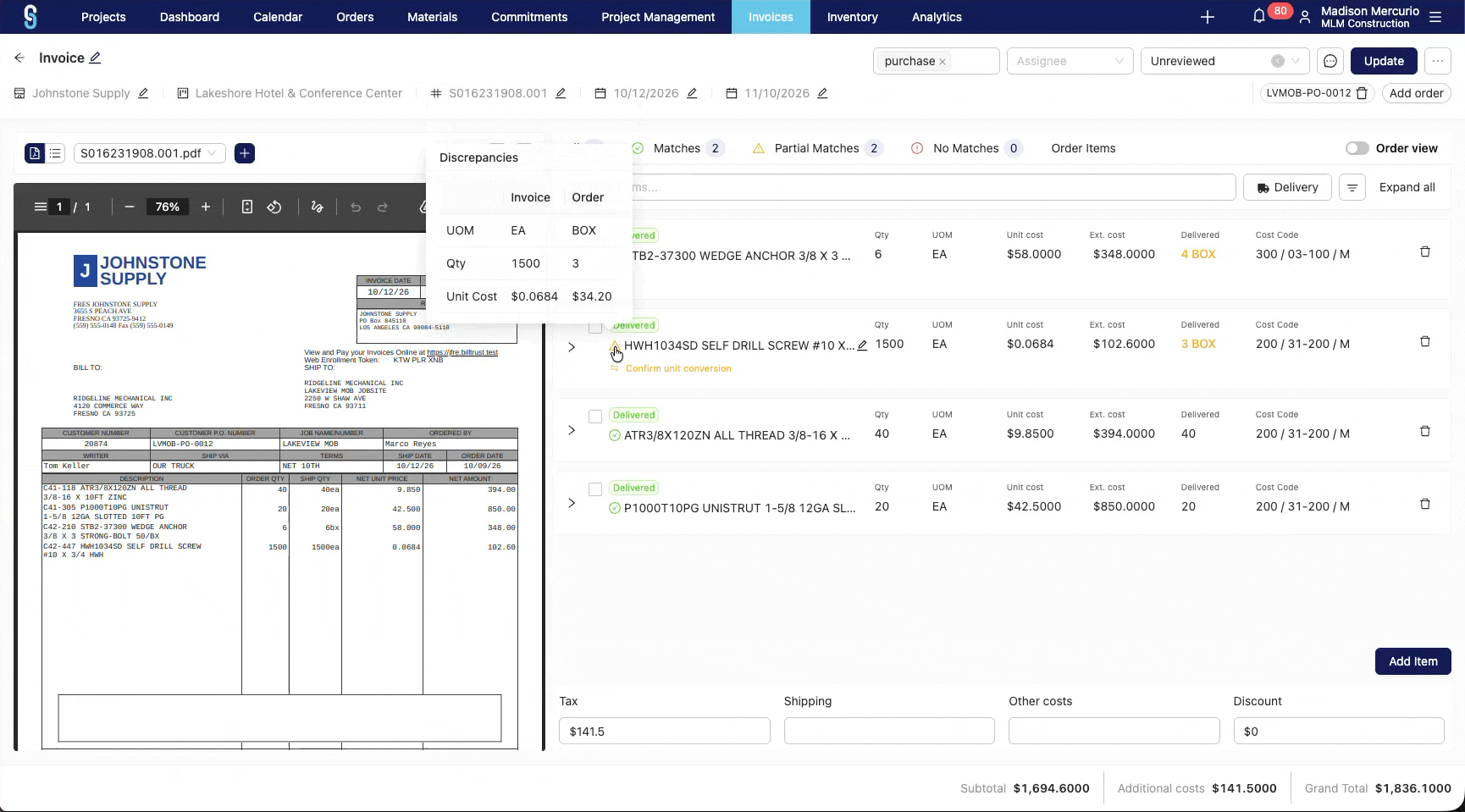
- SubBase matches the invoice line by line against the PO and the delivery ticket, and a person on the accounting team approves it before it syncs to the accounting system.
Where contract management meets the purchase order
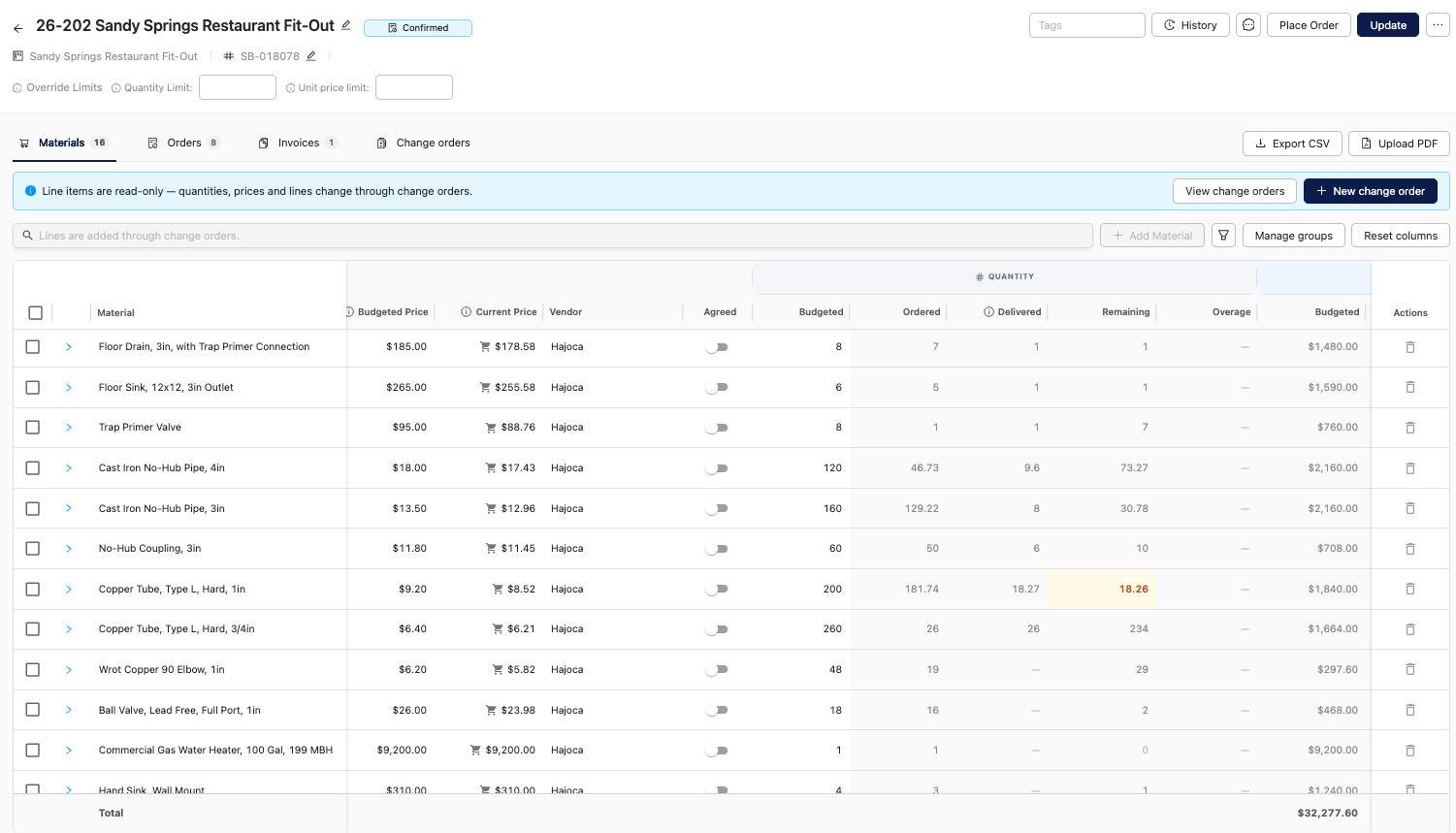
On the trade side, contract management for materials runs through the commitment: a master PO that holds the estimated material scope for a job, with orders released against it as the field requests. Buyers see what has gone out and what remains, lock items to agreed vendor pricing, and send the commitment back out for fresh quotes when a job runs long. That keeps CMAR packages and design-build scope changes from becoming surprises at reconciliation.
It also gives finance a number it can trust before project completion. "We can budget, forecast, and evaluate things better because the orders are all there," says Vivian Jimenez, Controller at JGR Construction.
On a long job with a master PO, how often should a buyer go back out for fresh pricing, and what signal tells you a price sheet has gone stale?
“On a long job with a master PO, I’d recommend reviewing pricing at first on a monthly basis, but more frequently for volatile commodities or materials with extended lead times. The tell that a price sheet has gone stale is when invoices start coming in at prices that don't match the agreed-upon numbers, or suppliers begin qualifying quotes with language like ‘subject to current market pricing.’ A master PO shouldn't mean you're locked into outdated pricing; buyers need to regularly validate costs with suppliers and document when pricing is protected, when it expires, and what triggers an adjustment.” - Eric Helitzer, LEED AP
See how a field request becomes a coded PO. Book a demo.
FAQs about construction procurement
What are procurement techniques?
Procurement techniques are the ways a buyer gets a price and commits to it, including competitive bidding, requests for quote, negotiation, and pre-agreed pricing under master or framework agreements. A trade contractor often uses several on one job, bidding the trade package to win the work and then running RFQs to buy the materials. The right mix depends on how fast prices move and how much volume is at stake.
What are some procurement tools?
Common procurement tools in construction include estimating and takeoff software, ERP and accounting systems, and materials procurement platforms that handle RFQs, purchase orders, delivery tracking, and invoice matching. Many contractors still run the materials side on spreadsheets, email, and phone calls. The gap shows up when an invoice arrives with no PO or cost code attached.
What are some best practices in procurement?
Keep one clean material database so the field, the office, and vendors use the same name for each item, which cuts the calls and manual re-keying when orders don't match. Set clear approval thresholds for who can buy what, and prequalify vendors on lead time and delivery record before a job starts. Track vendor performance against both requested and promised delivery dates to build stronger supplier relationships.
What is the difference between lump sum and cost-plus contracts?
A lump sum contract sets one fixed price for a defined scope, so the contractor keeps savings and absorbs overruns. A cost-plus contract reimburses actual costs plus a fee, which shifts more cost risk to the owner and gives the owner less cost certainty. A guaranteed maximum price is a cost-plus arrangement with a cap.
What is the difference between procurement and purchasing in construction?
Procurement covers the full process of getting work and materials onto a job, from the delivery method and contract to vendor selection and commitments. Purchasing is the transactional part inside it: issuing the PO, receiving the delivery, and paying the invoice. You can pick the right procurement strategy and still lose money if purchasing runs on texts and spreadsheets.
Your material spend should be visible on every job, under any contract. See how SubBase handles it, from the field request to the reconciled invoice. Book a demo.


Stay in touch
Sign up for our monthly newsletter to receive exclusive company updates, learn about industry trends and find out where we will be next. Don't miss out – subscribe today!

