
Material Procurement in Construction: A Contractor’s Guide

What is material procurement in construction?
Material procurement in construction involves sourcing materials, buying them, tracking line item deliveries , and paying for them against a project budget. It's the part of construction management that touches the estimate, the project schedule, and accounting at once.
For an owner, procurement often means buying large packages on bid day. A self-performing trade contractor places a steady stream of smaller orders every week across multiple projects, each tied to a cost code and an invoice that has to match the project specifications and the order.
How does the project delivery method shape construction procurement?
The project delivery method decides when a trade contractor's pricing work starts. Whatever the construction procurement methods upstream, the trade contractor still owns the weekly buying once work begins. Whatever the construction procurement methods upstream, the trade contractor still owns the weekly buying once work begins.
Why are construction material costs harder to plan for right now?
Construction material prices and lead times are moving fast enough that last month's quote is no longer a reliable number. Two recent data points show the pressure:
- Prices: Associated Builders and Contractors reported that construction input prices rose 6.2% in the first four months of 2026, with nonresidential input prices up 7.4% year over year.
- Lead times: Building Design + Construction, citing Skanska's summer 2026 data, reported structural steel lead times of 40 to 50 weeks in some markets and HVAC equipment lead times of up to 52 weeks.
For mechanical and electrical contractors, one material shortage caused by supply chain disruptions can push the project timeline as hard as it hits the budget. Procurement teams buying off old price sheets absorb the difference in their margin.
The six stages of the construction procurement process
Every material order moves through the same six stages, whether a company runs them on a phone and a spreadsheet or in procurement software. Successful procurement requires coordination between the field, the office, accounting, and vendors at each one.
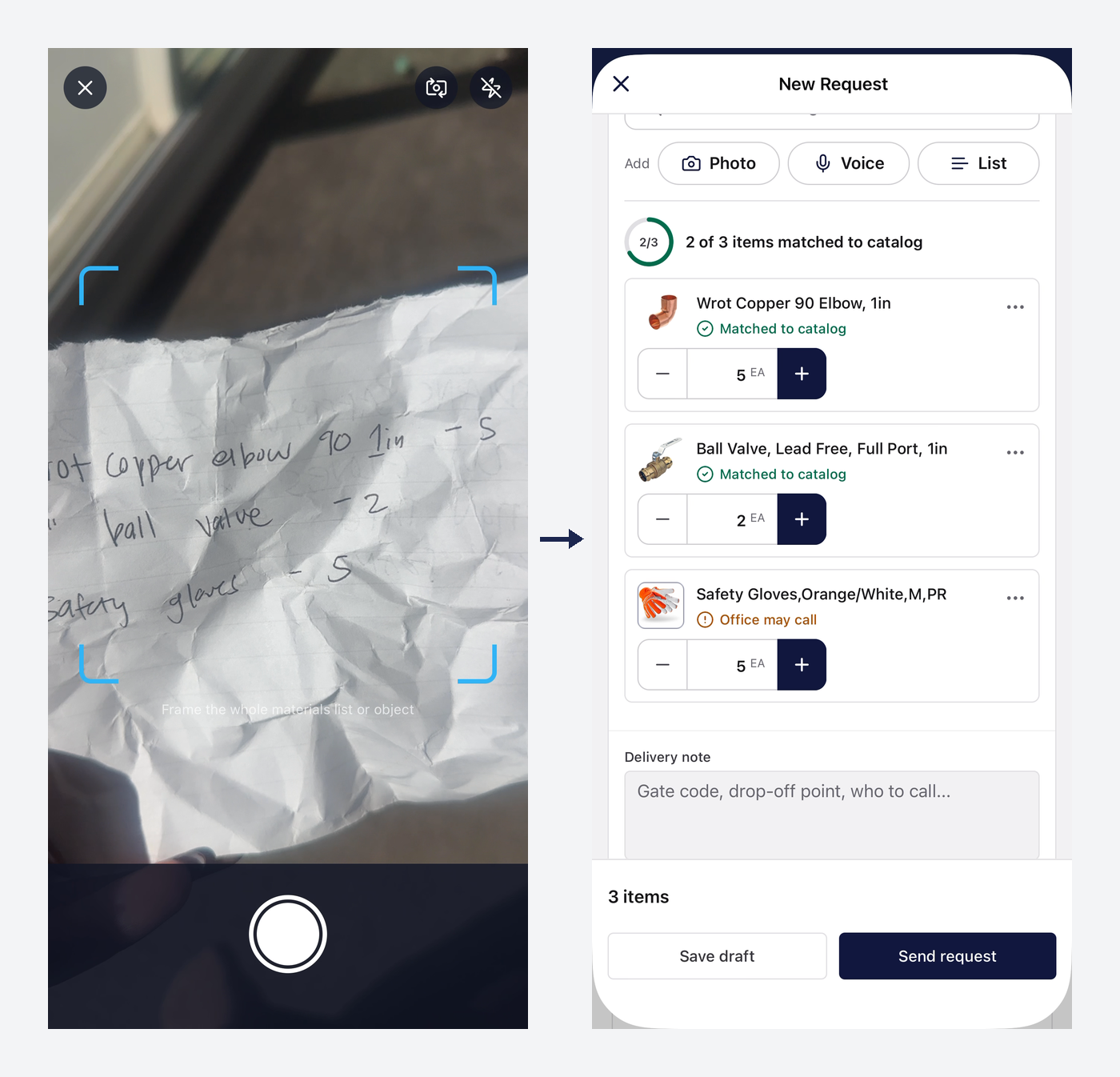
- Request. The field asks for material by call, text, photo of a handwritten list, or a structured request tied to the budget.
- Review and stock check. A project manager or purchasing manager confirms the item meets quality standards and checks inventory before buying outside.
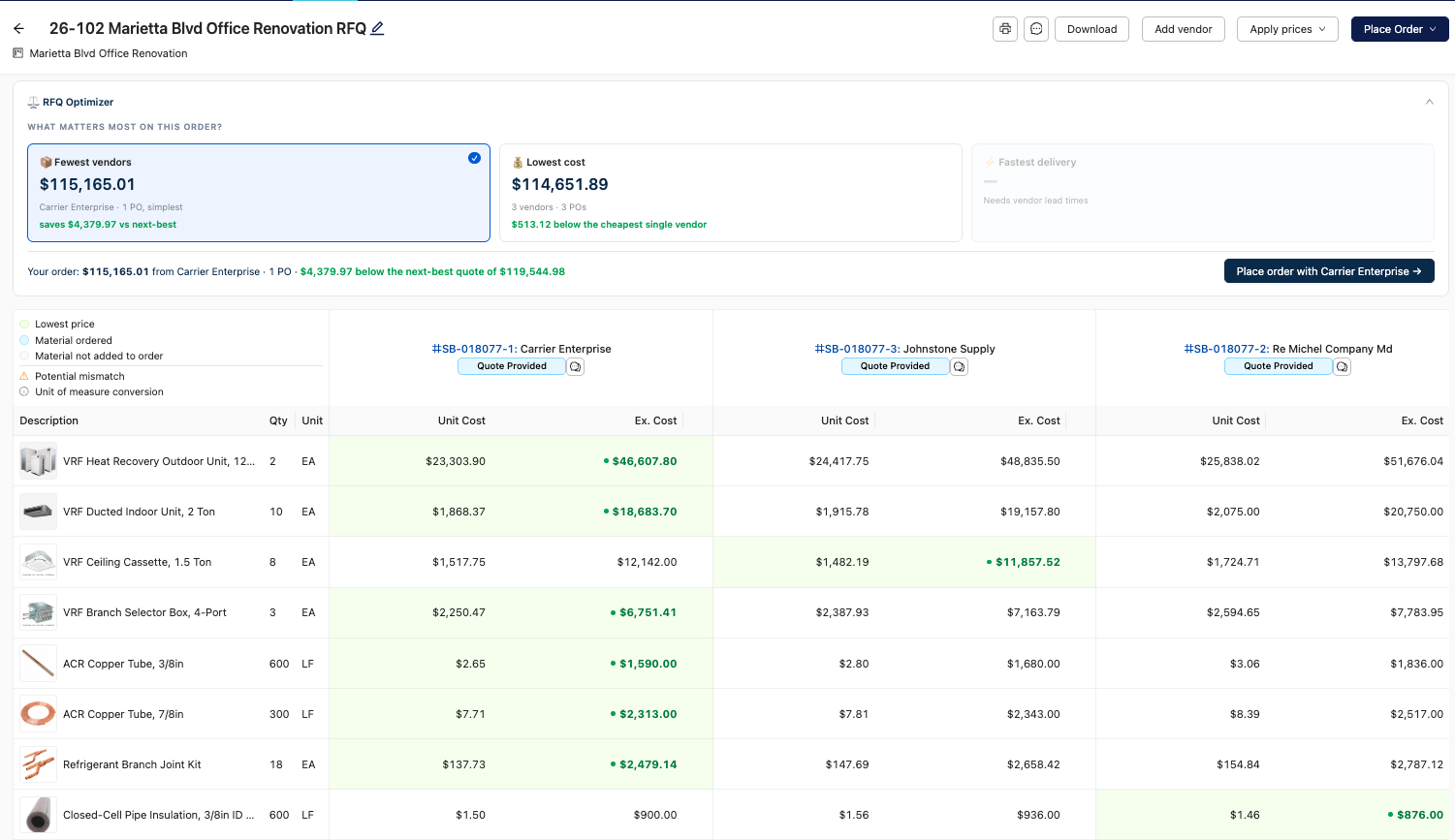
- Pricing. An RFQ goes to vendors, and the returned quotes get leveled on price, lead time, or number of vendors.
- Purchase order. The PO goes out with each line item coded to the right job and cost code.
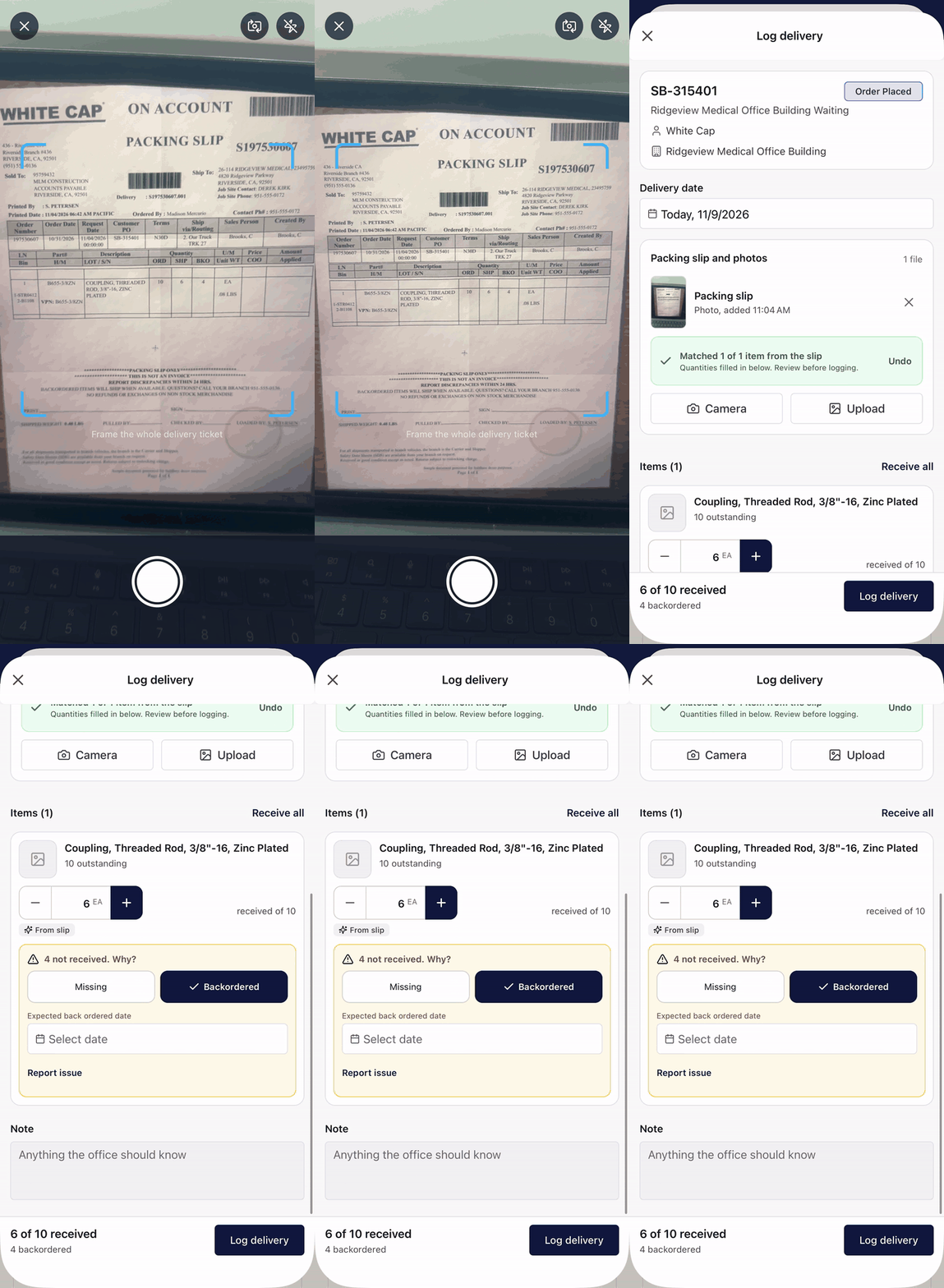
- Delivery. The field logs proof of delivery and flags backorders, missing items, or damage.
- Reconciliation. The invoice is matched line by line against the PO and the delivery record (the three-way match) before it reaches accounting.
Where do construction projects lose money in procurement?
Construction projects lose money at the handoffs between stages, where information moves from one person or system to another and something gets dropped. Each leak is small. Across multiple projects and hundreds of orders, they add up to budget overruns nobody can trace to a single decision.
If these warning signs look familiar, read up on the construction procurement bottlenecks that hurt margins.
When you look at a contractor's purchasing process for the first time, which handoff do you check first to find where material dollars are leaking, and what's the tell that it's broken?
“The first handoff we look at is between the field team requesting materials and the person responsible for purchasing them. That’s where leakage often starts: when purchase orders aren’t tied back to the original request, most are buying outside approved channels, or what was ordered, what was delivered, and what was invoiced don’t match. If you can’t clearly connect those three things, you’re likely losing material dollars through price discrepancies, duplicate orders, waste, or missed opportunities"- Eric Helitzer, LEED AP
Want to see where your material dollars go between the request and the invoice? Book a demo with SubBase.
Procurement strategies by purchasing model: which one are you running?
The right procurement strategies depend on how a company already buys. Most construction firms run one of three purchasing models, and each strains differently as the company grows.
What's the moment a contractor realizes its project managers have become a part-time purchasing department, and what usually breaks first when that happens?
“The moment you know it’s happening is when project managers are spending more time chasing quotes, tracking down materials, and coordinating deliveries than actually managing the job. What breaks first is consistency: purchasing becomes reactive and fragmented, teams lose visibility into what’s being bought and at what price, and the company starts relying on individual PMs instead of a repeatable process to control material spend.” - Eric Helitzer, LEED AP
How do you manage construction procurement risks and supplier relationships?
Managing these risks comes down to locking in what you can, re-pricing what you can't, and catching delivery problems before they reach the invoice.
- Commit pricing early. A commitment, or master PO, holds a job's estimated material scope at agreed pricing, and orders release against it. It brings contract management discipline to materials.
- Re-price long jobs. When a job runs long, send the commitment back out for fresh pricing.
- Track requested and promised dates. Vendor performance against both informs future procurement decisions and gives you facts for contingency plans.
- Catch backorders at delivery. A backorder flagged at the job site gets resolved that week. One found at invoice time becomes a dispute.
Strong supplier relationships make each of these easier. Vendors who get clear RFQs, clean POs, and two-way communication respond faster and flag problems earlier, which helps ensure materials arrive when the construction schedule needs them.
With some lead times running close to a year, what do contractors who stay on schedule do at the PO stage that everyone else skips?
“The contractors who stay on schedule bring their key suppliers into the conversation during preconstruction, not after the project is underway. By involving suppliers early, they can validate lead times, identify potential bottlenecks, and plan procurement around the project schedule. At the PO stage, they lock in delivery commitments and milestones rather than simply documenting what they’re buying. The biggest mistake is assuming that once a PO is issued, the materials are taken care of.” - Eric Helitzer, LEED AP
How does procurement software support effective construction material procurement?
Procurement software built for construction keeps every order on one record, from the field request to the reconciled invoice, so the field, the office, accounting, and vendors stop retyping information at each handoff.
What changes on everyday orders
In SubBase, the shared record changes construction material procurement for the team in a few ways:
- Cost codes go on at the time of the order and carry through to reconciliation, so project costs show up before AP touches the invoice.
- One RFQ goes to several vendors, and quotes come back leveled side by side. Contractors using SubBase report 3 to 8% cost savings from that pricing discipline, a customer-reported range rather than a guarantee.
- Each invoice is matched line by line against the PO and proof of delivery, and mismatches get flagged for a person to review.
- Vendors participate free, and AI handles tedious matching (like connecting a loose field description to the right catalog item) for the purchasing manager to confirm.
This procurement automation also helps integrate procurement with the accounting system. Skipping it carries the hidden costs of manual entry in construction procurement: staff hours and errors that never appear as a budget line.
How KD Construction centralized material procurement
KD Construction, a structural concrete and drywall contractor, moved from phone calls, emails, and handwritten notes to centralized purchasing on SubBase. The company reports a 22% reduction in material costs and more than $1M in material savings in its first year. "SubBase has transformed the way we handle procurement at KD Construction," said Purchasing Director Jennifer Hux-Aklar. Those figures are KD's own and reflect a full shift from fragmented to centralized buying.
See how a field request becomes a coded PO. Book a SubBase demo.
Effective procurement starts with the field
Effective procurement depends on the field using the system, because every order starts with a field request. If requests keep arriving by text, the rest of the process inherits the mess.
Keep the field's part small
Crews have been handed construction technology before that added steps, and that skepticism is earned. A request should take seconds: speak into a phone or tablet, snap a photo, or type. In return, supers see what's ordered and when it's coming without calling the office, which is where real collaboration between field teams and office staff starts.
Vendors belong in the same record. JGR Construction Controller Vivian Jimenez has said that "there are a lot of suppliers embracing SubBase."
Audit your procurement process in five questions
Before changing tools, answer these about your current process:
- How long does an invoice sit before someone knows its job and cost code?
- How many open orders have no confirmed delivery date?
- When did you last get competitive bids on your 10 most-bought items?
- Who records backorders, and who follows up?
- Can anyone report this month's material spend by project without waiting for invoices?
Frequently asked questions about construction procurement
How do you track construction procurement deadlines?
Track two dates on every order: when the field needs the material and when the vendor promised it. Tie long-lead items to the project schedule at the PO stage so slippage shows up early. A shared order record lets project managers and the field see delivery schedules without chasing vendors. The need date comes from a construction procurement schedule, which works back from each install date to the day the order has to go out.
What's the difference between procurement and purchasing in construction?
Purchasing is the transaction: placing the order and paying for it. Procurement covers the whole process around it, from defining project requirements and material sourcing through pricing, delivery, and reconciliation. Most cost leaks on construction projects happen in those surrounding steps.
Can contractors bring their existing material list into procurement software?
Yes. Contractors can import an existing material list, so the team doesn't rebuild its catalog from scratch. The import is also a good moment to clean up duplicate items, since the same product often lives under several names.
Do vendors have to buy new construction technology to work with a contractor's procurement system?
With SubBase, vendors join free and don't need to buy anything. They receive RFQs, confirm orders from their phone, and message the buyer in the same thread, so contractors can usually bring their existing suppliers along.
Know what you're spending on materials this month? Let's talk. Contact SubBase.

Stay in touch
Sign up for our monthly newsletter to receive exclusive company updates, learn about industry trends and find out where we will be next. Don't miss out – subscribe today!

