
How to manage your material database

Why most material databases are a mess
The original sin is usually naming. One vendor calls it "2x4x8 SPF Stud." Another calls it "Dimensional Lumber 2x4." Your foreman requests it as "studs." All three end up as separate line items and none of them talk to each other.
Multiply that across every material category, every vendor, and every person who has ever entered something into the system, and you end up with a database that can't be trusted for forecasting, can't be used for historical cost analysis, and creates friction every time someone tries to match an invoice.
It feeds construction material waste too, because when the same item lives under three names, nobody can tell what's already on site before the next order goes out.
The other common approach is leaning on the accounting system as the source of truth for materials. Accounting systems aren't built for that. They don't communicate with the field, they don't hold vendor-specific product details, and they weren't designed to handle the volume and variety of a busy subcontractor's purchasing operation. Excel spreadsheets are the fallback, and they have the same problem: manual to update, easy to corrupt, impossible to scale.
That same fragility runs through the whole manual purchasing process, where the order, the delivery ticket, and the invoice each sit in a different place.
The result is that every company ends up developing their own workarounds, patching inconsistencies as they go, and never quite getting on top of it.
What a well-managed database actually gives you
When your material database is clean and current, three things get easier.
Historical analytics become useful. You can see what you paid for a material last quarter, on which project, through which vendor. That's not just interesting, it's the basis for accurate estimating and vendor negotiation.
Forecasting gets reliable. When every item is named consistently and coded correctly from the moment it's requested, your committed spend figures reflect reality. You're not guessing what's been ordered against a budget line. You know.
Invoice reconciliation gets faster. When the item on the invoice matches the item on the PO because both pulled from the same database with the same naming convention, the match is automatic. The discrepancies that do appear are real ones worth investigating, not noise created by inconsistent data entry.
That's when a line-by-line three-way match can run without someone rechecking descriptions by hand.
Clean data is also what makes AI invoice matching work, since the system can only flag real discrepancies when the PO and the invoice describe items the same way.
How subbase handles it
SubBase lets you build a single, centralized material database that becomes the source of truth for everyone who touches the purchasing workflow.
You control the nomenclature. Field teams select from a locked list of items built around your naming conventions, not whatever they happen to type into a text field. That consistency flows through from request to PO to invoice, keeping the data clean at every step without requiring anyone to manually clean it up after the fact.
Vendor information is preloaded. Product details, units of measure, and pricing sit against each item in the database. Field personnel can see exactly what they're ordering, including images where relevant, which reduces the back-and-forth that happens when a request isn't specific enough. Accounting gets accurate data in real time rather than trying to decode a handwritten description on a delivery ticket.
The database evolves with your operation. New materials get added. Vendor details get updated. Pricing gets refreshed. It's not a static spreadsheet that's accurate on day one and drifts from there. It's a live record that stays current because the purchasing workflow keeps it that way.
A database that stays current is the backbone of material management, because every price, quantity, and cost code on a job traces back to it.
Grycon, one of Miami's longest-running construction firms, started from SubBase's catalog of coded materials and added its own items and cost codes during onboarding.
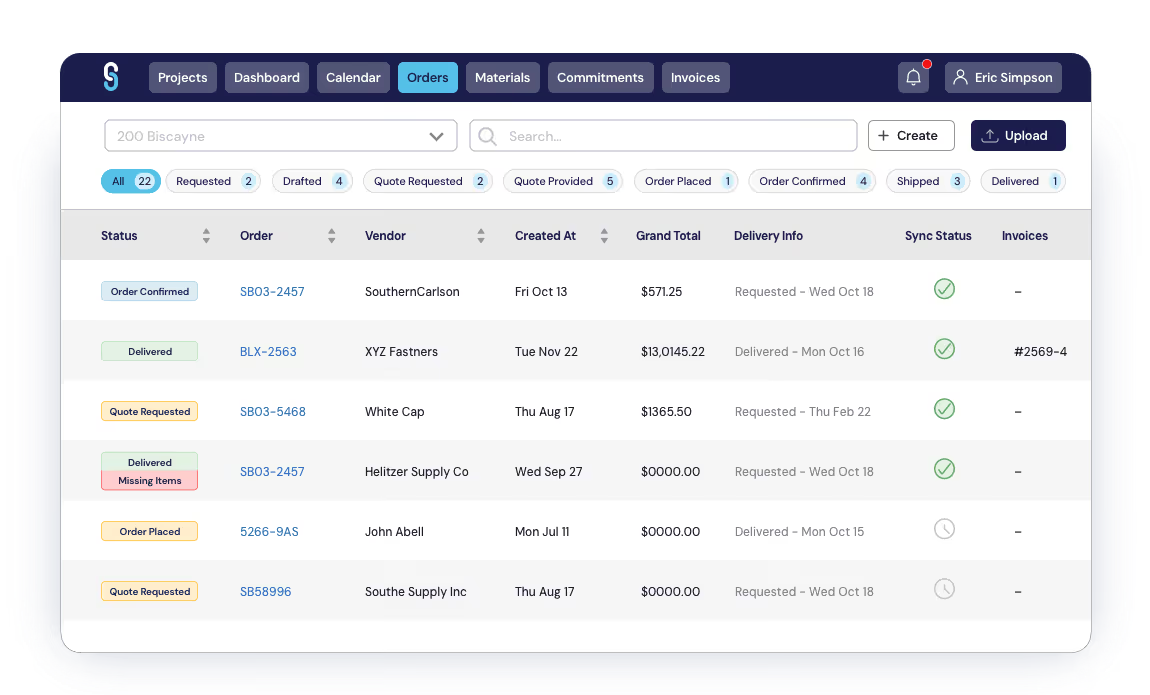
A messy material database isn't just an admin problem. It's a cost problem. The errors it creates show up in invoice mismatches, budget discrepancies, and forecasts that can't be trusted. Getting it organized is one of the highest-leverage things a subcontractor can do for their purchasing operation.
It's also the first thing to get right before moving purchasing into construction procurement software, since every request, PO, and invoice pulls from it.
Book a demo to see how SubBase handles it: https://www.subbase.io/subbase-demo



Stay in touch
Sign up for our monthly newsletter to receive exclusive company updates, learn about industry trends and find out where we will be next. Don't miss out – subscribe today!

